

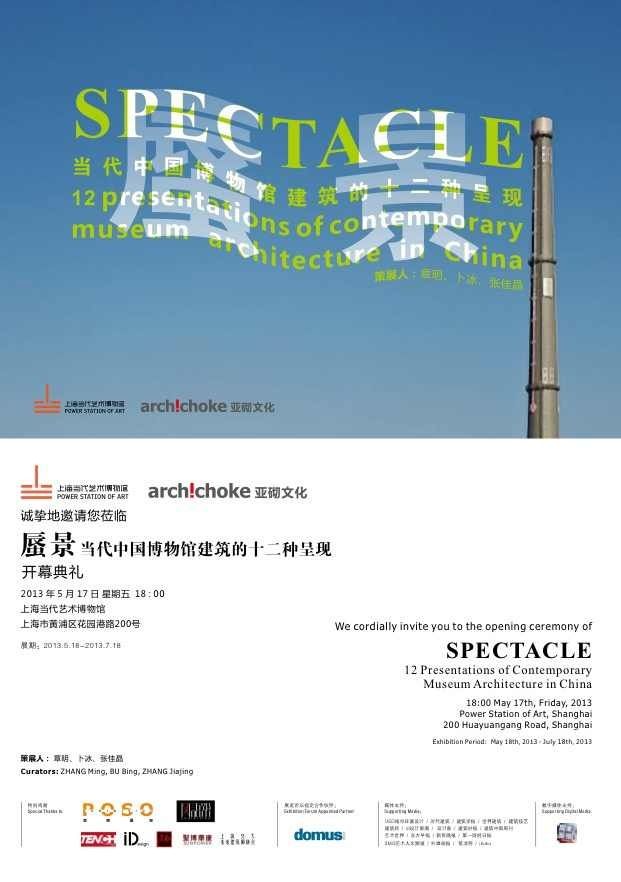
5月17日上海開展:蜃景——當(dāng)代中國(guó)博物館建筑的十二種呈現(xiàn)
蜃景
當(dāng)代中國(guó)博物館建筑的十二種呈現(xiàn)
主辦單位:上海當(dāng)代藝術(shù)博物館,ARCH!CHOKE亞砌文化
開幕時(shí)間:2013年5月17日,18:00,星期五
展期:2013年5月18日 - 2013年7月18日
場(chǎng)館:上海當(dāng)代藝術(shù)館3樓 | 亞砌文化飛行館
策展人:章明,卜冰,張佳晶
參展藝術(shù)家:劉家琨
都市實(shí)踐(劉曉都 / 王輝 / 孟巖)
原作設(shè)計(jì)(章明 / 張姿)
集合設(shè)計(jì)(卜冰)/ 柴濤
高目設(shè)計(jì)(張佳晶 / 黃巍)
哥倫比亞大學(xué)建筑規(guī)劃與歷史保護(hù)研究院中國(guó)大型城市實(shí)驗(yàn)室(杰弗瑞·約翰遜/卓·佛羅倫斯)+SLAB(杰佛瑞·約翰遜/吉爾·萊克納)
俞挺
袁烽
致正建筑(張斌 / 周蔚)
阿克米星(莊慎)
馮路 + 劉宇揚(yáng)
未知博物館
沈忠海
博物館建筑在呈現(xiàn)景象之余自身也往往成為城市的景象,這形成了一種復(fù)雜的觀看與被觀看的關(guān)系。景象在疊加中模糊并形成光暈,在饑渴消費(fèi)景象的現(xiàn)代社會(huì)中,這些帶著光暈的博物館就不可避免成為被賦予神圣意義的物體而非場(chǎng)所而得到崇拜,建筑師也往往以博物館建筑的設(shè)計(jì)機(jī)遇為榮。
與中國(guó)迅猛的城市發(fā)展速度同步,近年來博物館建筑同樣以令人難以置信的速度在各地被建造,其中不乏優(yōu)秀之作。但正是這樣一種近乎瘋狂的規(guī)模與數(shù)量讓我們感到難以在這里用一種傳統(tǒng)的建筑展覽方式去表現(xiàn)這個(gè)話題,我們或許可以通過模型,照片,圖紙去呈現(xiàn)其中一鱗半爪,卻不足以探討這個(gè)宏大景象背后的深層問題:博物館建造與使用、公共空間與私人領(lǐng)域、呈現(xiàn)與觀察、事件性與日常性。。。
所以,在這次展覽中,我們?cè)噲D呈現(xiàn)而非再現(xiàn),讓十二組建筑師或藝術(shù)家以博物館為題,用泛視覺藝術(shù)的方式,以自己的角度去重新表述博物館建筑。
章明與張姿的大型模型裝置作品直切展覽主題,以兩組截然不同的博物館類型:“大的和小的”,并置呈現(xiàn)而建立張力體系,既反思其一端的圣殿情結(jié),亦質(zhì)疑另一端對(duì)個(gè)人表述的迷戀。
展覽中有兩組作品以本次展覽的主場(chǎng)地--上海當(dāng)代藝術(shù)博物館為題材創(chuàng)作,張佳晶將博物館建筑連續(xù)剖切以去除“建筑的傲慢”,卜冰與柴濤的視頻組合裝置則混合了博物館內(nèi)外多角度視角的錄像與監(jiān)控鏡頭,嘗試反轉(zhuǎn)博物館參觀中的看與被看關(guān)系。
馮路與劉宇揚(yáng)通過網(wǎng)絡(luò)平臺(tái)向建筑師征集了大量未建成的博物館建筑模型。線上與現(xiàn)場(chǎng)的同步展示,以及微博等網(wǎng)絡(luò)媒體上的討論回饋共同構(gòu)成了這件作品。
建筑師都市實(shí)踐與劉家琨在這次展覽中都展示了各自的博物館建筑作品。都市實(shí)踐在展廳現(xiàn)場(chǎng)重構(gòu)了他們所追求的“最大包容性的公共空間”;劉家琨則以循環(huán)播放的兩段錄影資料介紹了他的兩個(gè)博物館作品。
Jeffery Johnson領(lǐng)導(dǎo)的哥倫比亞大學(xué)中國(guó)大型城市實(shí)驗(yàn)室團(tuán)隊(duì)的作品直觀展現(xiàn)了令人驚訝的建造規(guī)模與形態(tài)多樣性,這幅作品來自于他們目前正在進(jìn)行中的當(dāng)代中國(guó)博物館建筑的研究工作,他們以冷靜的視角在中國(guó)瘋狂的建造活動(dòng)中尋找或許能夠影響全球博物館發(fā)展的新趨勢(shì)或新榜樣。
未知博物館是一個(gè)對(duì)制度化博物館持續(xù)展開批判與反思的藝術(shù)家團(tuán)體,他們這次的作品借畫計(jì)劃討論的是如何幫助藝術(shù)從博物館走入私人空間領(lǐng)域。
袁烽的作品未來博物館的全息蜃景討論了時(shí)空維度的可能性,利用最前沿的全息投影技術(shù)嘗試呈現(xiàn)多維空間存在的狀態(tài)。俞挺以折射的鏡面呈現(xiàn)出的扭曲景象質(zhì)疑文化建構(gòu)中所謂正見或偏見的不可避免的主觀性。
沈忠海以職業(yè)攝影師身份記錄了外灘美術(shù)館的建設(shè)全過程,但在工作同時(shí)他也捕捉了美術(shù)館內(nèi)外各種鮮活的人物活動(dòng)。在他看來對(duì)后者的記錄與前者同樣重要:不同階層的活動(dòng)共同構(gòu)成了真實(shí)而矛盾的當(dāng)代都市歷史。
致正設(shè)計(jì)工作室與阿克米星建筑事務(wù)所的作品飛行館一號(hào)是亞砌文化飛行建造計(jì)劃的啟動(dòng)項(xiàng)目,也是本次展覽中唯一一個(gè)外場(chǎng)作品。博物館與公共空間行為的關(guān)系將是這個(gè)作品的核心看點(diǎn)。
我們期待透過這個(gè)展覽能夠引發(fā)更加積極深刻的批判態(tài)度,而不是對(duì)建造太快太多的簡(jiǎn)單膚淺的批評(píng)抱怨。我們承認(rèn)高速大規(guī)模的建造活動(dòng)對(duì)建筑師而言是挑戰(zhàn)更是一種難得的創(chuàng)作機(jī)遇,同樣,我們期待這樣的大規(guī)模建造現(xiàn)象也能夠給建筑師,知識(shí)界,以至廣泛大眾帶來深度思考的機(jī)遇。透過這幅宏大絢麗的蜃景,讓更多的人看到我們擁有著什么,將得到什么,這將是我們呈現(xiàn)這個(gè)展覽的最大收獲。
SPECTACLE
12 presentations of contemporary museum architecture in China
May 18th, 2013 - July 18th, 2013
Opening: May 17th, 2013, 18:00, Friday
Venue: 3/F, Power Station of Art | Archichoke Aviation Influenza
Artists: LIU Jiakun, Urbanus (LIU Xiaodu/WANG Hui/MENG Yan), Original Design (ZHANG Ming/ZHANG Zi), One Design (BU Bing)/CHAI Tao, GOM (ZHANG Jiajing/HUANG Wei), China Megacities Lab/GSAPP Columbia University (Jeffrey JOHNSON/Zoe FLORENCE)/SLAB Architecture (Jeffrey JOHNSON/Jill LECKNER), YU Ting, YUAN Feng, Atelier Z+ (ZHANG Bin/ZHOU Wei)/Archmixing (ZHUANG Shen), FENG Lu/LIU Yuyang, Museum of Unknown, SHEN Zhonghai
Curators: ZHANG Ming, BU Bing, ZHANG Jiajing
Organizers: Power Station of Art, Archichoke
Museum presents spectacle as well as being a spectacle in the city. This creates the intricate relationship of watching and being watched. Spectacles overlap and blur, creating the halo of the museum architecture. In modern society which is desperately eager to consume spectacle, museum as a haloed spectacle has increasingly become the object to be worshipped rather than a place for worshipping. Partly for this reason, Museum projects are also considered as most desired and proud of opportunity to architects.
In the past few years, new museums have been constructed all over China in an unprecedentedly quantity and scale. As excellent works are emerging, we found it a critical moment to reflect on such new museum architecture. However, the conventional way of architectural exhibition, with models, photographs, or drawings, can only display piecemeal vignettes of the selected works rather than their potential role in contemporary China. We now need to explore new methods to investigate the social, cultural, and political transformation underlying the quantitative expansion, such as construction and usage, public and private, representation and observation, event and daily life, etc.
So we put together here presentations instead of representations in this exhibition. 12 architects/artists (groups) are invited to approach the topic of museum architecture in visual ways from a diversity of perspectives
ZHANG Ming and ZHANG Zi use a large-scale installation to present the tension and juxtaposition of two extreme trends of museum design: the “museum of largeness” to one end, and the "museum of smallness" to the other end. It reflects on the prevailing trends today to understand museum either as the “temple of art”, or as the “self-expression of artist”.
Both ZHANG Jiajing and BU Bing/CHAI Tao take the Shanghai Power Station of Art—the exhibition site itself—as the subject: ZHANG’s installation slides the museum into “9 Pieces” to eliminate the “proud of architecture”; whilst BU and CHAI’s video installation uses recorded videos and live monitor to reverse the relationship of watching and being watched in the museum.
FENG Lu and LIU Yuyang present a number of “unbuilt museums” collected from architects. The display is both on the exhibition site and on-line, with the discussions on Weibo and other network medias being an integral part of the work.
Urbanus’s Contemporary Art Center incarnates the idea of “Comprehensive Public Space” which they have been exploring in the past years; LIU Jiakun displays two of his design works via videos: the Luyeyuan Stone Sculpture Museum (2002), and the Hu Huishan Memorial House (2009).
The China Megacities Lab led by Jeffery Johnson brings a portion of their current research on the Chinese museum projects. The work tends to show us the vast quantity of museums being constructed in China, as well as their astonishing scale, formal diversity and iconic ambition. It explores the new trends/models that might mark a paradigm shift in how the museum project is defined.
The Museum of Unknown is a group of artists who attempt to reflect on the conventional museum institution. Their work explores the possibility of extending artworks from museums to the more private spheres.
YUAN Feng’s work “Museum in the Future” adopts the Holographic Projection method to display the juxtaposition of multiple temporal-spatial dimensions in the hyperspace. YU Ting uses mirrors to create a set of distorted visions, revealing the inevitable personal prejudices that exist in judging the "right view” from the “deviated view”.
As a photographer, SHEN Zhonghai recorded the entire construction process of the Rockbund Art Museum. People’s behaviors and activities, both inside and outside the museum, form an integral part in the narrative, representing the very real, dynamic condition of the contemporary urban history.
Atelier Z+ and ATELIER ARCHMIXING’s work AVIATION INFLUENZA is part of the AVIATION INFLUENZA project proposed by ARCH!CHOKE. It is the only exhibit that is placed outside the main exhibition site. The interrelationship between museum and public space is the highlight of the work.
The primary purpose of the exhibition is to stimulate more deep thoughts and critical reflections on the new museum architecture rather than repeating superficial complains about the over-speed or over-quantity. The large-scale construction activities in China today are both challenge and opportunity to the architects. It is also a critical moment for the architects, intellectuals, and the public to reconsider and re-assess architecture and urbanism. We do hope that the visitors can look through this gigantic and splendid mirage composed of any kind of spectacle shown in the exhibition, and start to think more about what we have had, and what we are pursuing.
發(fā)布人: | 發(fā)布時(shí)間:2013-05-02
| 點(diǎn)擊數(shù):
